
Exploring language teacher emotion regulation
Responsible for English language education: Sam Morris (Associate Professor)
2026/01/07
研究紹介
OVERVIEW
We interviewed Associate Professor Sam Morris (responsible for English language education) from the Center for Foreign Language Education and Research at Rikkyo University about his research and future plans.
Please tell us about your research topic and the research you are currently working on.
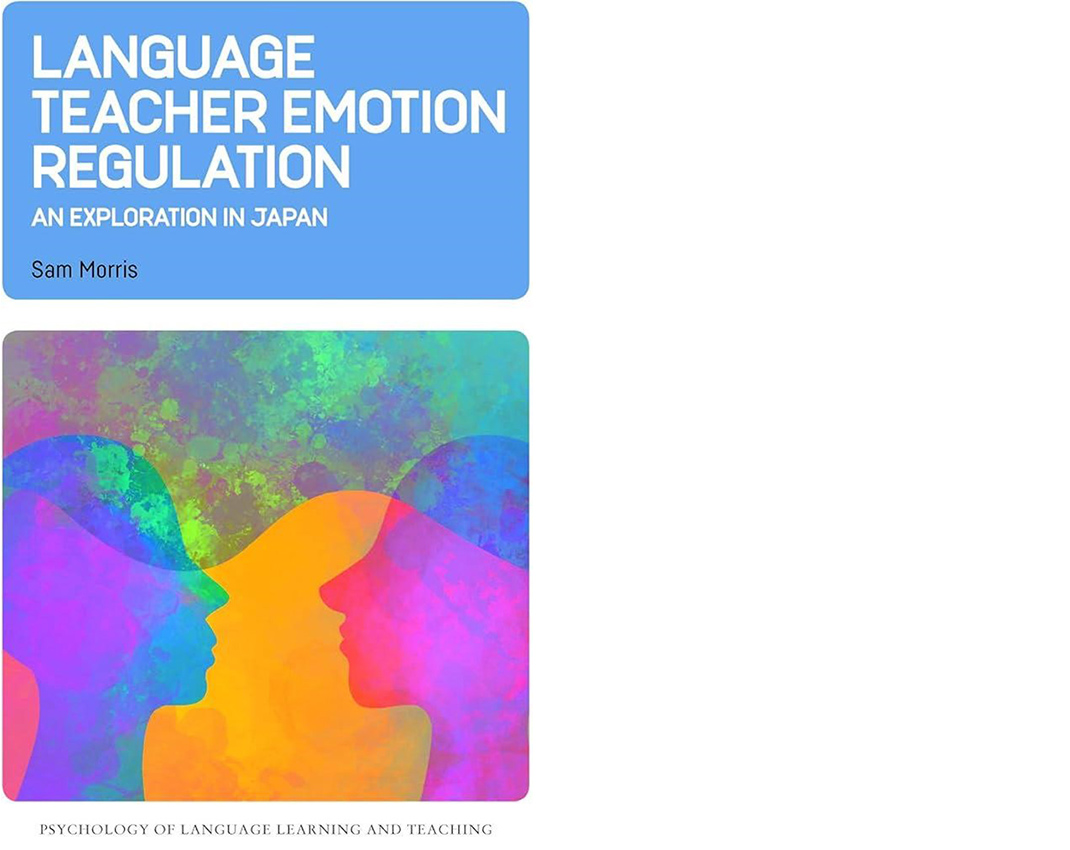
My first book - Language teacher emotion regulation: An exploration in Japan (2025), published by Multilingual Matters
My research interests lie in the field of language teacher and learner emotional psychology. In particular, I want to understand how and why language teachers regulate their emotions in their classes and work, and how we might train teachers to be better at this important skill.
Briefly speaking, emotion regulation refers to the decisions that we all make every day to manage the emotions we experience and the emotions we display to the people around us. In the classroom, these emotion regulation decisions are very important - the emotions that teachers feel and display have a profound impact on students and their success! Among other things, teachers use their emotions to build relationships, to manage behaviours, to create memorable lessons, to facilitate learning activities, and to motivate students to keep studying. Teaching is also a profession that may be considered emotionally demanding and stressful, and the ways that teachers regulate their emotions can have a powerful impact on their emotional health.
Briefly speaking, emotion regulation refers to the decisions that we all make every day to manage the emotions we experience and the emotions we display to the people around us. In the classroom, these emotion regulation decisions are very important - the emotions that teachers feel and display have a profound impact on students and their success! Among other things, teachers use their emotions to build relationships, to manage behaviours, to create memorable lessons, to facilitate learning activities, and to motivate students to keep studying. Teaching is also a profession that may be considered emotionally demanding and stressful, and the ways that teachers regulate their emotions can have a powerful impact on their emotional health.
Over the past 8 years, I have been working with teachers across Japan to better understand their emotion regulation decision making and the impact of personal, institutional, and contextual factors on such decisions. In 2025, I published my work in a book entitled Language teacher emotion regulation: An exploration in Japan (Multilingual Matters).
Presently, I am working on two research projects. The first is a government-funded study to design an emotion regulation training programme for language teachers. This training programme was successfully implemented for the first time in the spring of 2025, and I am now modifying the course to make it more accessible to teachers across the country. The second project I am working on is part of a large-scale effort involving numerous researchers within FLER to explore the use of AI and its impact on language acquisition. My contribution will consider how the rapid emergence of AI tools has impacted teachers’ and learners’ emotional experiences in relation to language learning.
Presently, I am working on two research projects. The first is a government-funded study to design an emotion regulation training programme for language teachers. This training programme was successfully implemented for the first time in the spring of 2025, and I am now modifying the course to make it more accessible to teachers across the country. The second project I am working on is part of a large-scale effort involving numerous researchers within FLER to explore the use of AI and its impact on language acquisition. My contribution will consider how the rapid emergence of AI tools has impacted teachers’ and learners’ emotional experiences in relation to language learning.
Please tell us how you became interested in your research.
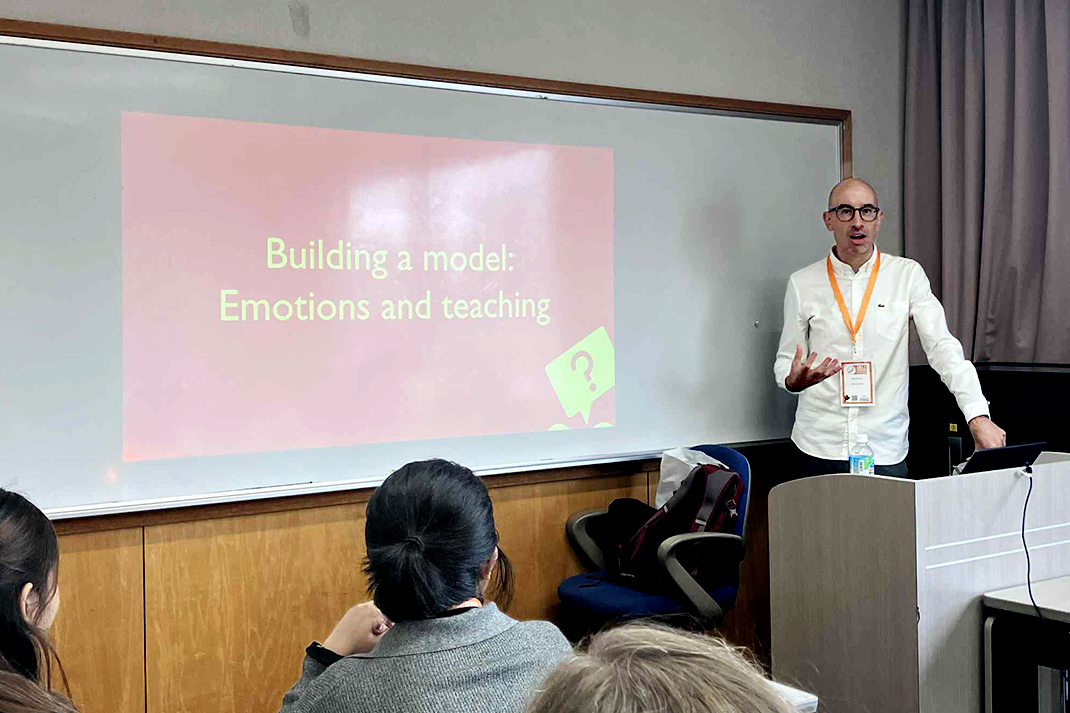
Presentation on language teacher emotion regulation in Tokyo, November 2025
When I began teaching at universities for the first time, I faced many challenges: How could I plan interesting and effective courses? How could I ensure that all students were engaged and learning? How could I provide feedback to large classroom groups effectively? How could I grade written work fairly? How could I make sure that students actually wanted to come to class? As I thought about the challenges I faced and reflected on my experiences, I came to realise that almost all of the challenges I faced involved either my emotions or the students’ emotions. Speaking to other teachers, I found that many people shared my experiences, and I also found other researchers who were exploring teacher psychology. Over time, I came to realise that understanding more about teacher emotions was an important and under-researched area of study.
I strongly believe that teachers want to be good at their job, and they want to help their students. At the same time, teachers are human. So, while they feel a great deal of joy in their work, they also feel worried, nervous, scared, guilty, and frustrated. What I have come to realise in my research is that managing emotions and managing learning often achieves the same goal, and moreover, that when a teacher has a good understanding of their emotions, students learn more.
What do you think is the most interesting and rewarding aspect of your research?
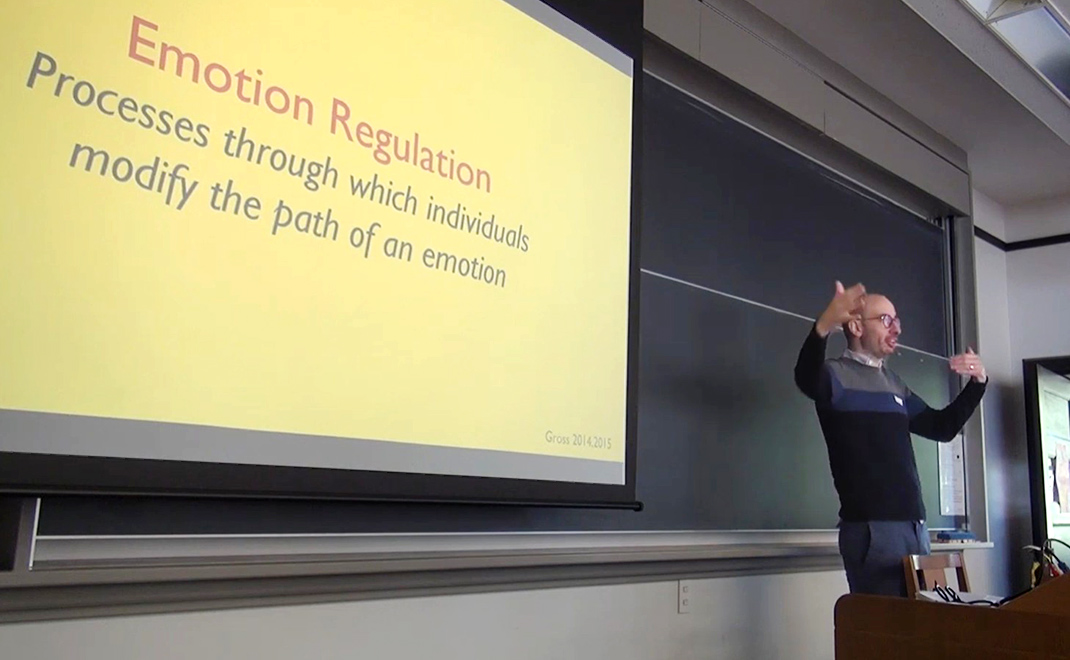
Delivering a training workshop to teachers at Rikkyo University, 2019.
I’m a very pragmatic person, and I want my research to make a difference. Therefore, the most interesting and rewarding aspects of my research have definitely been those times when I have been able to share what I have found, and when I have been able to help other teachers.
I see this most visibly in my current research project related to emotion regulation training. In the spring of 2025, I ran a training program with 13 experienced teachers in Japan. The teachers came from a hugely diverse range of backgrounds and teaching contexts, which was extremely eye-opening. I am coming to realise that teachers at every level (e.g., elementary, junior high school, high school, university) have completely different emotional challenges, and I am looking forward to working with more teachers in the future.
I see this most visibly in my current research project related to emotion regulation training. In the spring of 2025, I ran a training program with 13 experienced teachers in Japan. The teachers came from a hugely diverse range of backgrounds and teaching contexts, which was extremely eye-opening. I am coming to realise that teachers at every level (e.g., elementary, junior high school, high school, university) have completely different emotional challenges, and I am looking forward to working with more teachers in the future.
Please tell us about your experiences and what you learned during your student days (university, graduate school, studying abroad, etc.).
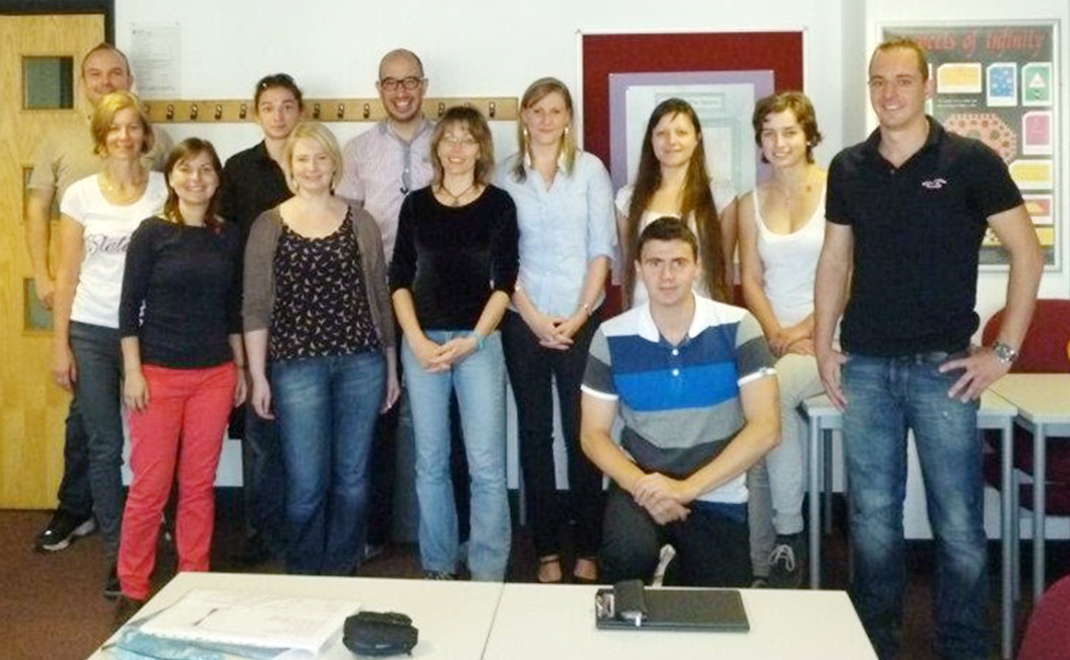
Teacher training during my Master’s degree - 2012
I was the very first person in my family to ever attend university, and at first, I really had no idea about what I was supposed to do and how I was supposed to learn. University was so different to my other schooling, and I remember that at the beginning I felt quite lost. Fortunately, my teachers were very supportive, and I came to realise that at university, I was in control of what, when, and how often I learned. I still believe that the most important thing a student can understand is that they are in charge of their own learning at university.
I have attended university twice more since becoming a working adult, firstly to complete my master’s degree, and secondly to complete my doctoral degree. In both cases, I learnt many things that I still put into practice every day in my current work!
I have attended university twice more since becoming a working adult, firstly to complete my master’s degree, and secondly to complete my doctoral degree. In both cases, I learnt many things that I still put into practice every day in my current work!
Please tell us about your current job at the university. What is it like? What are the fun and challenging aspects of it?
Since we have entered a new era of AI, one of the most interesting and challenging things about my job now has been trying to understand how we can support students to use AI in both effective and ethical ways, that actually improve their language abilities rather than replace them. This is not an easy challenge, because while AI could be a very useful tool for learning languages, if we are not careful and self-disciplined, it can also prevent us from learning a language.
Certainly advanced technologies are able to make our lives easier, but at the same time, there is something wonderful about being able to communicate with people from other cultures without having to use a computer or mobile phone within the middle of the conversation. I still see that as being a very relevant and desirable skill for humans to have.
Certainly advanced technologies are able to make our lives easier, but at the same time, there is something wonderful about being able to communicate with people from other cultures without having to use a computer or mobile phone within the middle of the conversation. I still see that as being a very relevant and desirable skill for humans to have.
Future plans
In the future, I want to continue to learn about the relationships between teachers, their emotions, and student outcomes, so that we may be able to best support teacher and student success. I am very much looking forward to developing my teacher training programme in this area, and I hope that I can discover ideas that can benefit teachers from a huge range of teaching contexts.
※記事の内容は取材時点のものであり、最新の情報とは異なる場合があります。
